Showing posts with label Articles. Show all posts

Wednesday, February 13, 2013

“Man…how do I rig up for this?”

…how do I rig up for this?
by: John Garrett – Feb, 2013 
So, here we are on the verge of a Centerpin explosion in the Pacific Northwest. A lot of folks are intrigued and asking questions. Northwest Fisherman are quickly learning what our Northern neighbors in Canada have known for years! And that’s the efficiency and the effectiveness of using a centerpin rod & reel to catch steelhead. All you have to do is watch someone who is remotely experienced with the technique and you are left in awe. In my conversations with friends and clients, we’ve often mentioned that it should probably be illegal. In my opinion there’s no other technique that’s as deadly effective when it comes to bringing steelhead to hand. I’m sure there are a few side-drifters out there that would beg to differ, but when you put a float on the line…centerpinning is the champion – Hands Down!

Wednesday, January 9, 2013

Slow Down for Winter Steelhead Success

These days it is so common to see boat after boat glide down drifts side drifting. Of course this technique is deadly and one I use quite often only with floats and center pin rods. However, time and time again I have found success by slowing down and really working a piece of water. Savvy side drifters will run laps in a piece of water but only certain water types allow for doing laps. Run and gun steelheading certainly pays off when conditions are right. However, when water and air temperatures plummet, slowing down is often the ticket.

Late December catch on the Clackamas
Using center pins, I like to sit on anchor almost in-line or just off to the side of the water I want to fish and I work it. With cold winter-water temperatures, fish are less eager to move. Sometimes almost bouncing your offering off their noses is the only way to get a response. The picture below was taken in late December when the air temperature was in the high 30’s and water temperature on the Clackamas River was 39 degrees. I spent over an hour in a small piece of water working different lanes and changing presentations, and it paid off. Multiple boats had gone through this water making a quick cast on the way by, finding no takers. Of course it helps to know where fish are caught consistently so you can feel confident spending a lot time in a piece of water, but when air and water temps are cold, try slowing down and put in time giving fish multiple looks, and it just might pay off.
Northern Oregon Coastal Catch
Here is one last example to illustrate my point. Last winter I fished a popular northern Oregon coastal river and found the usual crowds on a Saturday during winter steelhead season. As we headed up river to launch we counted boats at each put in looking for the “less crowded” drift. We settled on putting in very high up knowing that we were behind around 35-40 boats. Almost all of these boats were side drifting and covering a lot of water. We took our time sitting and working water content to be last. By moving slowly and using center pins we ended up landing 11 fish and hooking may others.

Some days slowing down can be the ticket.  


- Todd Harris, Harris Anglers

Thursday, May 31, 2012

"The New Kid On The Block"


Guide Rod Griffin admires the fruit
of his passion!
"THE NEW KID ON THE BLOCK IN THE PACIFIC NORTHWEST" - Part Two
by Rod Griffin, Owner and Guide at Griff's Fly Fishing Adventures

To read part one: scroll down.


THE NUTS AND BOLTS:.
I am a “figure it out for yourself” kind of guy.  I have to chew on all the information I can find on a subject and then put it to work my way.  Learning how to fish with centerpin equipment was no different.  I wasn't sure that it was something I was going to really like at first.  So, I didn't want to invest a bunch of money in gear that I may only use a few times.  I had no one close by that was into a centerpin so I could give it a try.  Probably a good thing, because there is a learning curve involved - especially the casting.  It takes some coordination to get it done.

My friend Bruce Belles, the main man, at Clackacraft Drift Boats recommended that I start out with some equipment made by Okuma.  He said - “I have all kinds of rods and reels, but I have found Okuma rods and reels to be more than adequate for the job at a very reasonable cost.”  So, taking Bruce's advice, I bought a 13 ½ ' Okuma Guide Select Rod and Aventi Reel.  Bruce also recommended Raven mono – so that is what I did along with Raven fixed balsa floats in different sizes.  I now have several different rods, and a Ross Flow Reel, but I find myself using the Okuma set-up more than not.  I caught a steelhead at Effy's Bridge on the Methow with it the first time I used it.  It is still catching fish.  The moral to this story: “you do not need high priced gear to get it done and have fun doing it.”  Also, if something happens to it you don't panic.  After all, you bought it to fish with.  I just got a new TFO 13' rod and it is a great rod.  They were not building them when I got started.

When it comes to terminal gear, I use Raven 8 or 10 pound Hi-Vis yellow mono mainline, swivels, split shot, and floats.  It is what I started with and it works just fine.  Raven has a system they have developed, and I follow that system with a few little changes here and there.  Again, I was following their system when I landed my first steelhead with a pin.  “If it ain't broke don't fix it.”  I have used this set-up on the Methow, Grande Ronde, and Wenatchee with a few subtle changes here and there; such as float weights and shape and bug size and weight and caught fish lots of fish.


Using a pin is about having what I call an “educated finger,” just like using a bait caster is about having an “educated thumb.”  It is important in making the cast, but it is also important in getting the right kind of drift.  I will talk about the cast first only because you can't fish unless you get your offering into the zone.  I call it the “zone” because with steelhead an inch one way or the other can make all the difference.  And like fly fishing - managing line and presenting your offering properly is in my opinion at least 90% of it if not more.  In other words it is important.


I watched and read everything I could on casting.  I tried most of them too.  I did not want to be one of those guys that can stand at the top of the drift or in a boat and just drop it in the water.  A “one drummer” I call them, not that it doesn't get the job done.  I do a lot of walk-in stuff on the Methow, in fact, I prefer it to being in the boat when it comes to steelhead. The reason why has nothing to do with this article; so I am just going to leave it at that.  I knew to be effective in the rivers I fish; I had to be able to cast most anywhere I wanted.  I can with the two casts that I use most of the time.  They are also the casts that I teach to my guests.  They are the “Side Cast” and the “Pulling Side Cast.”  The one down side for both of these casts is: line twist.  It is important to keep fresh line on your reel.  One thing that works for me is:  I use either Dacron fly line backing or heavy mono backing on my reels with Raven mono in hard to see green blood knotted to the backing.  I then blood knot the quantity of Raven Hi-Vis line that I use to fish with to the green mono.  This way I am only changing out the line that is on the water and used for casting most of the time.  Works for me, and it is kind of like using tips on a Scandi or Skagit Head.


Now that you have your line in the water; you have to learn how to control your float so you maximize your effectiveness and catch fish.  I do this using either the little finger of my right hand or the one next to it.  I like to use a high rod tip and a controlled drift, retarding the float just a bit, to get kind of a “trotting” affect or movement with the float throughout the drift.  I like the top of my float tipped upstream a bit.  This presents your offering in front of everything else so the fish see it first.   I also believe that the little bit of movement you get in the bug is very enticing to the fish.  It is just plain “sexy.”  I do this by putting just a bit of finger pressure on the freewheeling spool – either slowing it down or releasing and letting it move faster.  This method is very affective for working in and around rock pockets, etc.  I can tell you all about it, but it is definitely something you have to figure out for yourself.  You'll know when it is right.

When it comes to what I use in my offering, I prefer nymphs or a little smaller than the norm jig style hook with custom colored 1/32 ounce heads in a variety of patterns, mostly marabou,  that are more like a fly than a jig.  My best friend here in the Methow has a custom jig operation, Raven Jigs, and makes some of the best steelhead patterns around.  They also fish very well on a fly rod.  Sometimes in a river like the Ronde or the Klickitat I will use a heavier bug.  Fishing nymphs with a pin is also very affective.  Sometimes I fish two bugs, but there are also times when I will fish only one especially here in the Methow.  These Methow fish are very, very, trouty, and I have, over time, have gone to smaller and smaller bugs.  I very seldom fish egg patterns anymore, and lean towards size. 14 and 16 standard nymph patterns like Copper Johns, Pheasant Tails, Princes, Lightning Bugs, Hare's Ears, believe it or not.

SUMMARY:.
You know, I could probably go on and on and on.  It is kind of like that when you really enjoy what you do for a living.  For me I love steelhead, and I am thankful every day that God allows me to be doing something that I like outside in His creation.  I am first and foremost a two-handed rod angler when it comes to steelhead.  However, I am finding that more and more, especially in cold conditions, I am packing two rods with me.  My trusty Meiser or TFO Deer Creek and my pinning rod.  I like to swing through a run first to see if I can get a player.  Then more often than not, I will run the pin through it to see what I missed.  There are also those runs that are next to impossible to swing that hold fish in the winter.  I know how to nymph with a fly rod for steelhead, and I still do it with guests if that is what they want to do,  but more and more I am giving them a third option – the Centerpin.  And more and more of them are saying, “Yes.”

See ya on the river, Rod


Rod Griffin in Guide mode on the sticks

"THE NEW KID ON THE BLOCK IN THE PACIFIC NORTHWEST - Part 1"

By Rod Griffin, Owner and Guide at Griff's Fly Fishing Adventures
May 30, 2012

It is interesting how we evolve as anglers.  I have done it all.  I have drifted with conventional tackle. I have back-trolled plugs from both a drift boat and a jet sled.  There was even a time when I drifted bait with a noodle rod.  And then came fly fishing.  Fly fishing has been my choice of angling for close to 30 years now. Yeah that’s right, even before "A River Runs Through It."  On the rivers that I fish today, I use both single-handed and double-handed fly rods.  I really like using the double-handers including the relatively new switch rods that are available today.  I use an 11 ft. 5 weight for trout here on the Methow and for bass on the Okanogan, Lower Yakima, and Grande Ronde.


I am a steelhead bum at heart, and there is no better way to pursue them then being armed with a double-handed rod.  I prefer to swing flies for steelhead.  And for these east-side summer runs, the best time for that is in the warmer months, with late August through the first part of November being prime time.  The conditions at this time of year, especially the water temperatures, are ideal for swinging with a dry line.   I like 11 ft. to 13 1/2 ft. two-handers with compact Scandi heads for this job. As the water temperatures fall below 45 degrees, the use of Skagit heads with sink tips becomes more and more critical to catching fish on the swing. Like it or not, I have had to accept that when it comes to catching steelhead with flies, the single most effective way to do that is dead drift nymphing with a dry line and bobber; just as you would for trout.  “UNTIL NOW!”

About five years ago, I got interested in a relatively new technique of steelhead fishing that was starting to show up in the Pacific Northwest.  Two friends, Bruce Belles and Eric Nuefeld, both highly regarded in the fly fishing industry started telling me about a technique called “the centerpin”.  I figured if Bruce and Eric are into it, it can't be all bad.  So being the open minded inquisitive guy that I am, I started doing some on-line research about it and was surprised at how much information, especially “YouTube” stuff that I found.

I am an east-side steelhead guide as I mentioned earlier.  This means, that I am dealing with summer run fish hanging out in very cold water from mid-November into February.  These fish are not very active residing in deeper, slower, pools and not really excited about moving to a swung fly.  As a result, I had to resort to using nymphing techniques to get clients into fish consistently.  After all, I do get paid to help people catch fish.  The Centerpin has given me another very effective weapon in my arsenal that is, in my opinion, probably the single most efficient and effective way to catch the great silver and Rose colored ghost of our Northwest Rivers.  Oh by the way, it is fun too! It’s a good balance between fly fishing and conventional gear fishing.

A TRADITIONAL METHOD OF FISHING:.
Centerpin angling is not a new concept.  It is really a traditional style of fishing, which like double-handers was born in the UK in the 1800’s.  It is very popular on British Columbia Steelhead Rivers and has been for many years.  In the U.S., it first started gaining a following in the mid-west and eastern states with the development of the steelhead fishery on the rivers of the Great Lakes. It is also   growing in popularity in Alaska.  Although relatively new in the Pacific Northwest, it is becoming more popular for steelhead.  More and more fly rod anglers are using this technique as an alternative way to catch fish when swinging just doesn't get it done.  Most are two-handed rod junkies who refuse to use a bobber with a double-hander.  Some Washington and Oregon fly shop owners have seen an opportunity to get in on the ground floor and are now stocking and selling center pin rods, reels, and gear.  Ross Reels is making a great center pin reel called the Flow, and some rod companies are designing, building, and marketing centerpin rods.  Both Loomis and TFO currently have center pin rods on the market.   Raven, a Canadian Company, makes rods, reels, and gear that are very popular in this country and throughout the world.   Okuma long known for quality, affordable, conventional equipment is making very good rods and reels that are very affordable and catch fish too. 
Releasing a centerpin caught steelhead

The theory behind this technique is a long, drag free drift. For me, it means that I can use this technique to help guests’ present subsurface flies or patterns using small jig style hooks in a way that is very enticing to a steelhead, especially during cold water periods.   The time of year when summer run, East side fish are not as easily moved to a fly; you have to bump them on the nose to get them to eat your offering.


THE EQUIPMENT:.
Centerpin reels are extremely smooth, machined, single-action reels much like fly reels of old with no drag system except for a clicker.  The clicker is used to keep the reel from rotating freely when not fishing.  It is not intended to be used for a drag.  In other words, if you put the rod tip in the air with your set-up hanging down without the clicker engaged everything will drop to the ground.  They have rimmed spools so the necessary drag is applied by hand when fighting a fish.  This, by the way, is the same way I fight fish on my fly reel.  I have never relied on the drag and prefer the old Hardy’s and click drag systems.  The rods are long, lite, and responsive.  Probably the most popular length of rod in the NW right now is 13 ft. or 13 ft. 6 in. rod.  I use both rods for what I am doing here on the Methow or any of the other east side rivers I fish.


I have been using a centerpin for three years now.  Like many other NW anglers, I taught myself. I read a lot of books, looked at a lot of websites, and asked a lot of questions; then put it all to work on the river. Trust me it is definitely a deadly technique for catching steelhead.  There is a learning curve, but that can be shortened by fishing with someone who has already made most of the mistakes.

Centerpinning is an awesome traditional approach to catching fish. The center pin can not only save the day, but is also a very pleasant, challenging way to fish.  Careful though, like fishing with a double-hander it can become addictive.  It is a great way to fish the Methow, Wenatchee, or Grande Rhonde throughout the winter.


Thursday, April 26, 2012

"Path To The Pin"

Angler's and the reward of pinning!
“Path to the Pin: Part Two”
By Todd Harris - May 10, 2012
To Read Part One Scroll Down.

Casting a center pin reel is unique and somewhat challenging. I recommend checking out some videos and putting in some practice. However, you can be successful without being a proficient caster. If you fish from a boat, then you may want to try the following technique whenever the water conditions allow.

Most of the time when I am guiding centerpin anglers, I will hold the boat IN the water I want them to fish, either by sitting on anchor, or working the oars, similar to plugging. Then, all that is required of the angler is to simply drop the offering in the water off the front of the boat, and let the current take the float downstream. The beauty of this technique is that there is no need to mend as you are fishing in-line with your float. Any necessary line management will be very minimal. This makes a huge impact on the quality of drift you can accomplish because your float is rarely disturbed due to mending and/or drag. The other nice thing about fishing this way is that you eliminate conflicting currents that may interfere with your drift. When your float gets to the end of the drift, reel up and drop it again. If you are working big water, simply change the lane you run each drift and you can effectively cover all the water. Again, this “in-line” method of pinning only works for certain water types that allow you to set up in-line with the water you want to fish.

Many pieces of water are going to be smaller, more defined, too fast, or for some other reason unfishable with an in-line presentation. In these scenarios, I will anchor up as close as I can to the holding water, again trying to avoid mending, drag, and conflicting currents. I always try to avoid long casts if I can. This just means more line on the water causing me trouble.

Water clarity also plays a huge role in how I fish. Obviously if you are fishing low, clear water, you would not want to anchor too close to the holding water. Centerpins really shine in low water due to the long drag-free drifts that you can get. I like to set up way above where I think fish will be and run really long drifts to avoid spooking fish with the boat.

Many times steelheading success is more about HOW you fish than WHAT you fish. “When steelhead are in the mood they will eat your car keys!” This quote came from one of the great pioneers of steelheading in the Northwest and rings in my head all the time. The discussion that followed was about how much more important all the other factors were and fly choice was more about your confidence. Many steelheaders get caught up in what they are fishing and fail to pay closer attention to how they are fishing. Again, the key to the success of the centerpin is in the ultimate presentation.

In part one I talked about how critical it is to get a dead drift. However, there are times when fish prefer a little more action. When fishing jig heads have you ever noticed that when dead drifted, the jig head is in front of the worm or jig feathers? Next time you’re on the river, drop your jig in the water and watch as it drifts, and you will notice that the heavy head will lead your worm or hair downstream. Something I have played with is putting very slight pressure on the spool as line is paying out, just enough to tilt your float back a little, and slow your drift slightly. What happens is your jig head will be held back just enough to allow your worm or feathers to “swim”. This idea came from my time swinging flies. When swinging, you want to get your fly under tension as soon as possible to impart that deadly swimming action. A dead drifted fly does not have near the action of a fly under tension. I think the same principle applies to jigs to a certain extent. I began to notice that a lot of my better pieces of jig water always had some amount of surface chop. This chop creates vital action on the jig. So, I started holding back my drift a little in water with little or no surface chop to create my own swimming action and found some good results. This can get tricky so another great option is to switch terminal gear for different water types. Typically whenever I have good surface chop, I will go with a pink worm or marabou/bunny jig. When I encounter relatively calm or slick-surface water, I will switch to a bead. I mentioned bead fishing in part one and highly recommend trying one in this type of water. Beads are meant to tumble naturally and fish really well in calmer water.

If you enjoy float fishing, you owe it to yourself to give centerpinning a try. I guarantee that after some practice you will be blown away by the drifts you can accomplish and how effectively you can fish all water types. When your first fish is hooked on a pin, you will enjoy the intimate, no-drag fight, and the ultimate feel of chrome throbbing on the end of a long,light rod, and you will be back for more!

“Path to the Pin: Part 1”
by Todd Harris - April 27,2012

Memories are funny, especially when it comes to steelhead. I have a hard time remembering many simple day-to-day things in life, but when asked about a fishing trip, whether it was recent or many years back, I am able to recount every fish, how, and where they were caught, and what the water conditions were like. My path to centerpin fishing for steelhead goes like this.

When I was six, I landed my first steelhead on a plug with my father on the oars; I remember that day well. I am now 35 and have been obsessed with steelhead ever since. I have gone through a progression of sorts in my steelhead pursuits. After landing my first fish on that plug, I wanted more! More became my goal on every outing for many, many years. When I would float a river, I had plug rods, drift fishing rods, and later bobber rods. I would fish each piece of water with the most productive technique. I had finely tuned plugs, good bait, hand tied jigs…The list goes on.

When I was a junior in high school, I asked for a fly rod for Christmas and my love affair with fly fishing began. My days of plugging, side drifting, diver and baiting, drift fishing, and bobber fishing with spinning gear were over. I sought out everything I could on fly fishing and eventually had my first “tug” on the swing and, to say the least, I was exhilarated. I found out how effortless two-handed rods were for delivering the fly, and soon all you could find in my boat was a quiver of two-handed rods rigged for swinging. I did nothing but swing for years. The days of big numbers were gone, but one on the swing was plenty.

One afternoon after swinging a run with a good friend of mine, we were sitting on his tailgate and he mentioned that he was looking to sell his centerpin gear. At this point, I had never even laid eyes on this stuff. He pulled out this long soft rod with a funny looking reel latched on by a couple of sketchy looking rings. He showed me the set up and explained that it is a deadly way to fish “floats”. Thus began the next phase in my pursuit of steelhead.

Catching steelhead on a swung fly is an amazing feeling, and I believe something every steelheader should at least try in his or her lifetime. I still love to swing, but I was always mindful that I was passing up a lot of greedy water that could not be fished with a fly. As I learned the deadly potential of a centerpin, I started swinging the good swing water and pinning the rest. This is where I am today and I love the traditional approach and the one- on-one fight you get with a centerpin reel. So, I would like to share some of what I have learned since that day many years ago when I first touched a centerpin reel in hopes that others might pick up on this challenging, yet highly effective, method of fishing.

I still get funny looks on the water here in the Northwest, as many anglers have never seen a centerpin reel in action. My fishing buddy who passed along his gear to me is from the Midwest where steelheaders have been pinning for a LONG time, and the tradition runs VERY deep with centerpins.  The question I get most often from my friends and clients is why use centerpin gear when you can fish floats with any type of rod and reel. My response is that you can accomplish the ultimate drift and maintain commanding control, it’s challenging, and it’s really fun to fight fish on. I float fished for years with spinning and level wind reels and I can tell you that you will LOVE the line control and the long unencumbered drifts you can get with a centerpin set up.

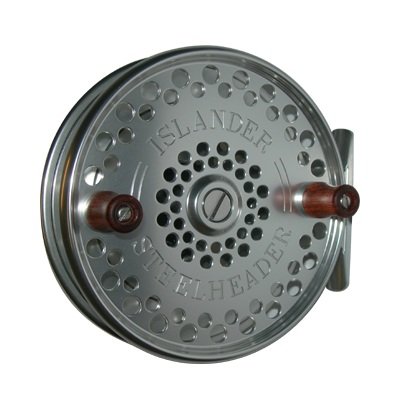
Getting started with a new technique is tough from a financial standpoint, and you have to be patient with the learning curve. As with everything fishing, one can spend a lot of money on gear or go cheap. Find what fits your budget and what you are comfortable spending. If you have the means, I would say put your money into the reel. I own Islanders and Ross. As for rods, my first was a St. Croix and no matter how hard I tried to break that thing, it just kept fishing. Now I own Loomis rods and they are incredibly light and sensitive. My favorite length is in the 11’3”-13’ range. They come in longer lengths but I haven’t seen the merit in the waters I fish. Load the reel with backing and top it with a highvis floating mono, like Raven mainline, and you are on your way.

Next comes how to rig this type of setup. To avoid the inevitable line twist that comes with most techniques of centerpin casting, you will want to tie a micro swivel to your main line. I use Raven 4X-small as they seem to pass through the guides relatively well, and I have yet to have one fail even on the occasional Chinook that decides to grab a steelhead offering. Next, the most simple rigging involves about 8ft of low vis mono or fluorocarbon. My mainline is 12lb so I use 12lb for this first section of my leader. The next piece is your float. The vast majority of the time a fixed float will do the job. If you encounter a piece of water that is really deep, you may need a slip float, which is a whole different set up. For this article I will focus on a fixed float rigging. Raven makes a variety of floats that will fit any water type you may encounter and they attach to your line with silicone tubing. One thing I have found is the 3/32” diameter tubing works best for the bottom AND top of the float. The smaller diameter on top tends to reduce float slippage when setting the hook. Having the float attached by only the tubing allows for quickly changing floats when needed.

Once the float is attached, tie on another micro swivel and about 3ft of 6-10lb tippet. Just remember that you do not want your total leader length longer than your rod. With this set up you should break off at the bottom swivel and save your float should you find a snag.

The final piece is what to fish as your offering. My first steelhead on a centerpin fell for a 3 inch pink worm on a ¼ ounce jig head under a FM 6.2 gram Raven float. To this day, that is one of my go-to offerings for winter steelhead. I like to keep things relatively simple, and it does not get much easier than a pink worm or hair jig under a float. One KEY is matching your float to the amount of weight you are fishing. You want your float to ride straight up and down when dead drifted and the color change should be right at the water line. I primarily fish two floats, again keeping things simple. The fast medium (FM) floats from Raven have a nice taper for most steelhead water with the 6.2g supporting a ¼ ounce jig head nicely and the 5.0g float supporting a 1/8 ounce jig head. I could go on forever about the subtleties of balancing a float, but this will get you in the game.

The other method I use quite often is a single trout bead pegged 2 inches from the hook. I have guided in Alaska for 12 years on the upper Kenai and have taken the bead form AK trout to Northwest steelhead and found amazing results. Fishing a bead requires distributing the weight down your leader, creating a “shot pattern”. This pattern of shot will help balance your float and correctly present the bead. Shot pattering can get very technical and I recommend doing some research. I learned by trial and error but as a general rule, I run 3-4 bb shot on the bottom swivel and spread shot out in 1-2ft increments until my float rides properly. Raven makes a variety of shot that will suit shotting for Northwest steelhead. Bead fishing for steelhead is catching fire, and fishing one under a float with a centerpin is a must for the bag of tricks.

When presenting a jig, or bead, or any thing for that matter with a centerpin, you want as close to a dead drift as possible and this is easily attained with a centerpin. Set your depth to within a foot of the bottom and cast your offering into likely water and let it run drag free. Adjust your depth until you touch bottom then come up just a bit to put your offering in the zone. Constantly adjusting your depth for each new piece of water is critical.

A drag free drift is the key to this technique, and the high-visibility floating monofilament will help you achieve a perfect drift. The concept of mending is known to fly fisherman and applies to float fishing as well. If you begin to develop a downstream belly in your line, lift your rod and manipulate your line to eliminate the belly. When mending, try not to disturb your float as it glides through the drift. LONG drifts are possible with a pin, but only allow your float to run as long as you can detect a strike. With the long rods used in centerpinning, you can set the hook at the end of an extended drift, just but be sure to swing big and reel until you feel the fish.

If all goes well and you end up tied into some chrome, then you will experience the give-and-take battle of fighting a fish on a centerpin. With zero drag you must finger or palm the rim of the reel during the fight. This takes some getting used to and is a lot of fun. The finesse involved makes landing a fish a bit more of a challenge than with other types of reels. In my next segment I will talk more on the finer points of how to fish a centerpin effectively.

Come back next week for part two of "Path to the Pin"...

  © Mike Prine 'and' Steelhead.com 2009/2010

Back to TOP